
Walk down any grocery aisle, and you’ll see dozens of bottles labeled “extra virgin olive oil.” But here’s the reality—many of them aren’t as pure as they claim. Between mass production, heat processing, and poor storage, much of what’s sold as “premium” olive oil has already lost the very compounds that make it real and beneficial. For anyone seeking authentic olive oil, this presents a real challenge. In this post, we’ll break down what authentic olive oil really means, what causes most brands to fall short, and how O-Liv has set a new standard for purity and potency.
The Truth About Olive Oil Purity—What’s Really in the Bottle?
It might be surprising to learn, but olive oil has a long and storied history of being one of the world's most frequently adulterated food products. For decades, investigative journalists and food scientists have uncovered widespread issues in the industry. Numerous studies, including well-known reports from institutions like UC Davis and investigations in the EU, have found that a significant percentage of imported olive oils labeled "extra virgin" fail to meet the legal standards for that grade.
This doesn't always mean the bottle is filled with something completely different. More often, it’s a subtle deception. The product might be a lower-grade, refined olive oil that's been deodorized and colored to look like extra virgin. Or, it could be real extra virgin olive oil that has been diluted with cheaper, highly processed seed oils like soybean, sunflower, or canola oil. In other cases, it’s simply old, rancid olive oil that has long lost its "extra virgin" qualities but is still sold under that premium label. The result is that consumers who are paying a premium for a high-quality, healthy product are often getting something else entirely.
A Billion-Dollar Industry With a Hidden Problem
The root of the issue lies in simple economics. Global demand for extra virgin olive oil has skyrocketed due to its reputation as a cornerstone of the healthy Mediterranean diet. Producing genuine, high-quality extra virgin olive oil is an expensive, labor-intensive process. This combination of high demand and high production cost creates a powerful financial incentive for fraud.
In many parts of the world, regulatory oversight can be lax, and testing is not always rigorous enough to catch sophisticated forms of adulteration. Deceptive producers exploit these gaps. By diluting their product or mislabeling a lower-grade oil, they can dramatically increase their profit margins. For the average consumer, who may not know the difference in taste between a real and a fake oil, it's an easy deception to fall for. This hidden problem undermines trust and makes it difficult for shoppers to find truly pure olive oil.
How Mass Production Compromises Authentic Olive Oil
There is a world of difference between a small-batch Mediterranean oil and one produced on an industrial scale. Authentic extra virgin olive oil is essentially fresh-pressed fruit juice. Its quality depends on gentle handling, speed, and minimal processing. Small, traditional producers understand this. They harvest their olives at the right moment, press them quickly, and bottle the oil with care.
In contrast, industrial-scale production often prioritizes volume and efficiency over quality. This can involve a number of shortcuts that compromise olive oil purity:
-
Mixing Oils: To achieve a consistent flavor profile year-round and keep costs low, large producers often blend oils from different regions, countries, and even different crop years. This makes traceability impossible and often involves mixing fresh oil with older, lower-quality stock.
-
Aggressive Filtering: While some filtering is normal, heavy industrial filtering is sometimes used to remove all sediment, creating a perfectly clear oil with a longer shelf life. However, this process can also strip out many of the beneficial polyphenols and flavor compounds.
-
Using Low-Quality Fruit: To maximize yield, mass producers may use overripe, damaged, or ground-fallen olives, which produce oil that is high in acidity and already starting to go rancid. This oil must then be refined to be palatable.
Heat and Refining—The Silent Quality Killers
The term "extra virgin" legally means the oil was extracted using only mechanical means, without the use of chemical solvents or high heat. Heat is a silent quality killer. While it allows producers to extract more oil from the olives, it destroys the very things that make olive oil special: its delicate flavors, aromas, and most importantly, its health-promoting phenolic compounds.
When an oil is made from poor-quality olives, it has flavor defects. The only way to make it sellable is to "refine" it. This industrial process involves high heat, pressure, and chemicals to strip the oil of its color, odor, and taste. The resulting product is bland, colorless, and devoid of nutrients. Sometimes, a small amount of virgin olive oil is added back for flavor, and the product is deceptively labeled as "Pure Olive Oil" or "Light Olive Oil." This is not real olive oil in the traditional sense; it is a heavily processed industrial fat.
Storage and Shipping—How Olive Oil Loses Its “Extra Virgin” Status
An olive oil can be perfectly authentic and high-quality the moment it leaves the mill, but loses its "extra virgin" status long before it reaches you. The three greatest enemies of olive oil are oxygen, light, and heat. Exposure to any of these will cause the oil to degrade and turn rancid.
Unfortunately, the global supply chain is often unkind to olive oil. The journey from a farm in Greece to a supermarket shelf can take months, with the oil sitting in warehouses and on cargo ships. If it's not packaged correctly, its quality rapidly declines. The most common mistake is packaging oil in clear glass bottles. While it lets the consumer see the green color, it offers zero protection from light. An oil sitting under the bright lights of a supermarket is constantly degrading, losing its flavor and antioxidants. Time is also a factor. Olive oil is best consumed within 18-24 months of its harvest, but many bottles only list a "best by" date, giving no clue as to the oil's true age.
Experience the Benefits of High-Phenolic Olive Oil
If you're learning about the science behind real, high-quality olive oil, take the next step and try it for yourself. Our oils are crafted to deliver the phenols and flavor your body actually notices.
Shop High-Phenolic Oils
What “Authentic” Olive Oil Should Really Mean
With so many misleading terms on the market, it’s important to reframe what "authentic" olive oil truly means. Authenticity is not just a marketing slogan; it's a set of measurable, verifiable standards. Real olive oil should be:
-
Single-Origin and Traceable: You should know exactly where it comes from, down to the region or even the estate.
-
Cold-Pressed and Unrefined: It must be extracted using mechanical methods only, without high heat or chemical solvents.
-
Lab-Tested: Its purity and quality should be verified by a third-party laboratory.
True authenticity is the combination of a traceable origin, a natural extraction process, and scientific verification. It’s about transparency from the grove to the bottle.
Single-Origin and Region of Harvest Matter
When you read an olive oil label, pay close attention to the language. A label that says "Packed in Italy" is not the same as one that says "Product of Greece." The former can mean that oils from various countries like Spain, Tunisia, and Turkey were shipped to Italy, blended together, and bottled there. A "single-origin" label, especially one that names a specific region, is a much better sign of authentic olive oil. It means the producer is proud of their product's unique character and is not hiding behind a generic blend. Sourcing from renowned regions like those in the Mediterranean, particularly Greece, is often considered the gold standard for quality.
Testing Is Non-Negotiable for Real Olive Oil
Your senses can tell you a lot about an oil, but the only way to be certain of its authenticity is through lab testing. Legitimate producers test their oil for key chemical markers that prove its quality. These include:
-
Free Acidity: A measure of the oil's freshness. For extra virgin status, it must be below 0.8%.
-
Peroxide Value: This indicates the level of oxidation. A low value means a fresher oil.
-
Phenolic Content: This is the ultimate measure of an oil's antioxidant power and a key fingerprint of its authenticity.
A brand that is truly committed to purity will make this information available.
The Role of Polyphenols—The Mark of Real Olive Oil
If there is one single mark of real olive oil, it is a high concentration of polyphenols. These natural antioxidant compounds are the source of the oil’s flavor, stability, and health benefits. They are the fingerprint of purity.
As we've discussed before, these compounds, like oleocanthal, are what create the signature peppery kick or tingle in the back of your throat. If your olive oil is bland, smooth, and tasteless, it's an almost certain sign that its phenolic content is low or non-existent. That throat tingle isn't just a quirky characteristic; it is the taste of a potent, unrefined, and authentic olive oil. It’s nature’s way of telling you that you’re getting the real deal.
Why Polyphenols Decline in Mass-Market Oils
The reasons for low polyphenol content in mass-market oils are the same ones that compromise their purity. Blending old oil with new, long storage times in warehouses, exposure to heat and light during shipping, and packaging in clear bottles all contribute to the rapid degradation of these fragile compounds. By the time that oil gets to your pantry, the powerful antioxidants that define real olive oil are long gone. This reality is what inspired us to find a better way to deliver olive oil’s benefits.
Featured Products

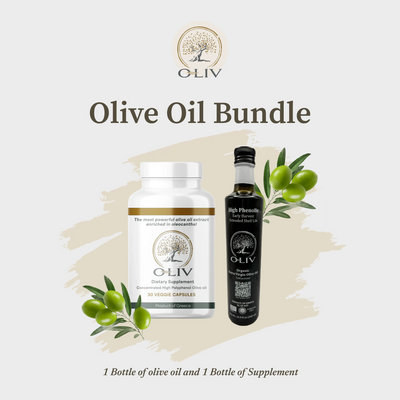

How O-Liv Meets and Exceeds Real Olive Oil Standards
At O-Liv, we don't just accept the standards for real olive oil; we aim to exceed them. Our entire process is built around a commitment to absolute purity and proven potency, starting from the source.
We source our oil exclusively from trusted groves in Greece, the historical home of authentic olive oil. But our commitment doesn't stop there. We use a proprietary preservation process and innovative capsule technology to protect the oil's integrity. By sealing the fresh, high-phenolic olive oil in a capsule, we shield it from the damaging effects of oxygen and light, ensuring it remains as potent as the day it was pressed. This delivery system also offers the benefit of zero calories and ultimate convenience, without any risk of oxidation from an opened bottle.
Tested for Phenolic Power and Purity
We believe that claims of quality must be backed by proof. That’s why every single batch of O-Liv is sent to an independent lab for a full analysis. We test for free acidity, peroxide levels, and a complete profile of phenolic compounds. This verification process ensures that each capsule delivers the concentrated polyphenol power equivalent to 1.5 tablespoons of premium liquid high-phenolic olive oil. We don't just say it's pure; we prove it with real data.
Sourced From Greece—The Home of Authentic Olive Oil
Our roots are firmly planted in the Mediterranean. We chose Greece as our source not just for its reputation, but for its generations of expertise in cultivating olive varieties that are naturally rich in polyphenols. By partnering with growers who use traditional, sustainable harvesting methods, we ensure that our oil starts with the highest possible quality, capturing the essence of the region’s authentic olive oil heritage.
What to Look For When Shopping for Authentic Olive Oil
Navigating the supermarket aisle can be tough, but you can arm yourself with knowledge. When looking for real olive oil, use this buyer’s checklist:
-
Harvest date and origin clearly listed: Look for a specific harvest date and a single country of origin.
-
Dark glass bottle or protective packaging: The container must protect the oil from light.
-
Single-origin labeling: This indicates traceability and is a better sign of quality than a vague blend.
-
Lab-tested or certified: Look for any mention of third-party testing or quality certifications.
-
Naturally peppery flavor: If you're able to taste it, a peppery finish is a great sign of high phenolic content.
The Future of Real Olive Oil Starts With Transparency
As consumers become more educated, they are starting to demand greater transparency from food producers. The future of the olive oil industry lies in traceability, verified purity, and honest labeling. Brands that embrace this new standard are the ones that will earn long-term trust. We are proud to be part of this movement, providing a product that is not only effective but is also completely transparent about its sourcing, its testing, and its quality.
See How O-Liv Redefines Real Olive Oil
O-Liv was created to solve the purity problem. We deliver what authentic olive oil promises: science-backed, Greek-sourced, high-phenolic potency that is lab-tested and verified. We’ve taken the guesswork out of finding a pure and powerful product.
Experience Authentic Olive Oil—Reinvented
See how O-Liv redefines real olive oil—backed by Greek tradition and modern testing.
These statements have not been evaluated by the FDA. This product is not intended to diagnose, treat, cure or prevent any disease.